
Vida Fitness — The 8 Faces of Sugar
An educational miniseries on how sugar affects your health
Why Do We Associate Sweets with Happiness?
How to reshape this emotional imprint for lasting well-being
 Versión en español
Written by: Prof.
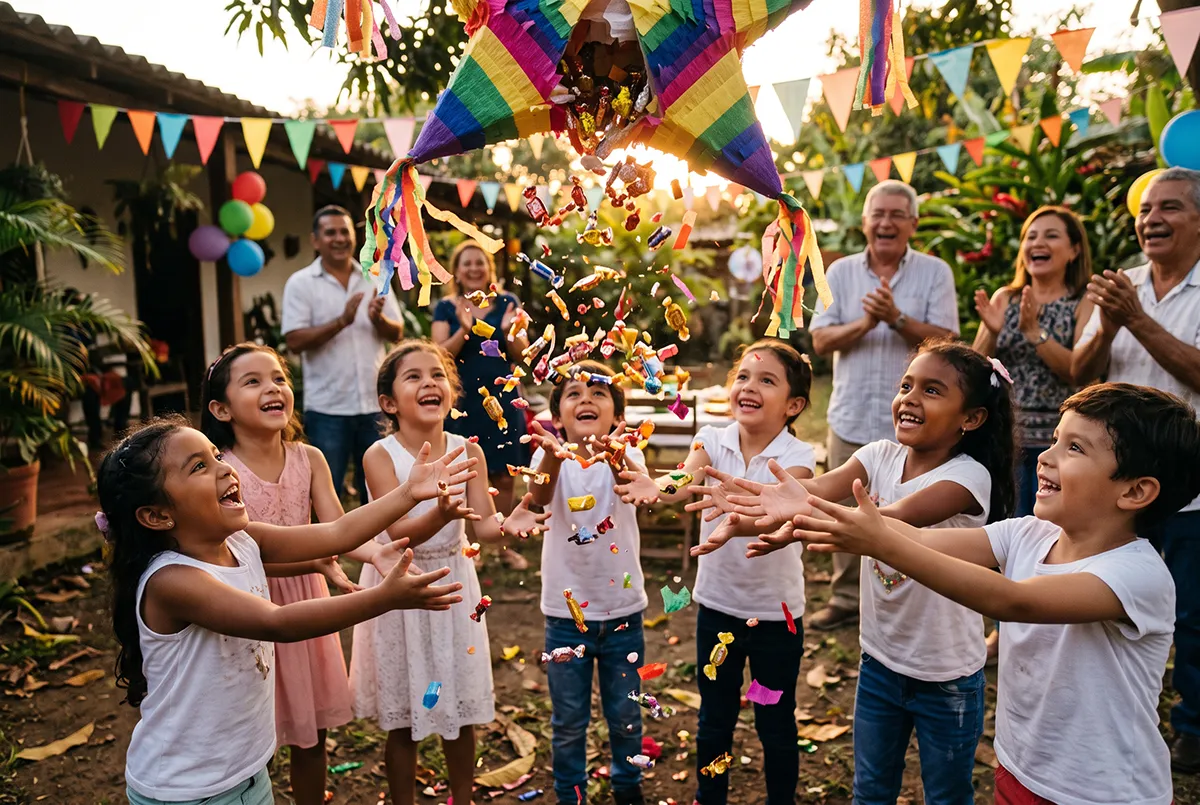
We learned that happiness tastes sweet amid applause, laughter, and piñatas. That lesson stayed with us long after the birthday candles were blown out.
Click to listen to the reading of my Article
Listen to my Podcast about this Article
I clearly remember the piñatas of my childhood. Besides small toys, they were packed with candies and bonbons. And it wasn't only at parties. Sweets came as a reward for a good grade at school, as comfort after a scraped knee, and as company during family afternoons.
Without meaning to, those who raised us taught us a simple equation: sweet equals happiness (Oudat et al., 2025; Sarkkola et al., 2025). That equation didn't stay in childhood. As adults, we often reach for sugar not out of hunger, but to relieve stress, fatigue, or sadness (Maqsood et al., 2025; Qin et al., 2025).
In this final article of the series on the faces of sugar, I want to go back to the root; I want to take a closer look at how that association was formed and how we can reshape it, changing it to improve our health.
When sweetness became a language of affection
In our homes, sugar has never been just an ingredient. It has been used as a gesture of love. The mother who adds an extra spoonful to the baby bottle, the grandmother who saves a bonbon for her favorite grandchild… In this way, sweetness became a way of saying "I love you" or "it's okay now."
Science has names for these habits. When food is used as a reward, it is called instrumental feeding; when it is used to soothe sadness or anger, it is called emotional feeding. A review of children aged 2 to 5 found that these practices, along with permissiveness, are associated with less healthy eating habits, while parental modeling and teaching are associated with better ones (Oudat et al., 2025).
The effect extends beyond early childhood. Among nearly 6,000 Finnish preadolescents, children whose parents comforted them with food were more likely to overeat (Sarkkola et al., 2025). And among more than 1,500 American adolescents, giving them sweets or sugary drinks "to make them feel better" was associated with higher consumption of these products, especially among young people who already tended to eat in response to emotions (Mason, 2024).
Researchers propose a plausible explanation: when we eat for reasons other than hunger, our natural fullness signals may become blurred (Sarkkola et al., 2025). These are association studies, not studies of cause, but the pattern is consistent: the learned link between sweetness and comfort tends to keep working as comfort.
What happens in the brain: dopamine, pleasure, and tolerance
Brain chemistry adds to that social learning. When we eat something sweet, the reward system releases dopamine in a region called the nucleus accumbens, producing a feeling of pleasure and relief (Maqsood et al., 2025; Qin et al., 2025). It is the same circuit that evolved to reward what keeps us alive, such as eating or drinking (Qin et al., 2025).
The problem comes with repetition. Pleasure reinforces the memory of sweets and the desire to eat them again, creating a cycle: sweets, pleasure, craving, more sweets (Qin et al., 2025). Over time, some studies describe a kind of tolerance: larger amounts or more intense flavors are needed to feel the same satisfaction. Stress, in addition, fuels cravings for highly palatable foods (Maqsood et al., 2025; Qin et al., 2025).
It is worth saying honestly: so-called "sugar addiction" is still a debated concept, and its withdrawal symptoms are much milder than those of drugs (Maqsood et al., 2025; Qin et al., 2025). The point is not to label ourselves as addicts, but to recognize that sweetness holds real power over us.
A curious fact helps us understand where that power lives. The tongue also gets tired of sweetness. One study found that after tasting the same sugary solution ten times in a row, perceived sweetness dropped by 27% to 38% with glucose and fructose, and by about 66% with sucralose. However, this was a short-term effect, measured within a single session, and people who consumed sweeteners daily did not perceive sweetness differently from those who did not (Okoye et al., 2025). This suggests that what draws us back to sweets is not a "worn-out" tongue, but a learning stored in our emotional memory.
How to reshape the imprint of sweetness
The good news is that what has been learned can be unlearned. Here are some simple choices supported by the evidence:
- Cut back on sweets little by little. Gradually reducing the spoonfuls in your coffee, juices, and desserts, instead of eliminating them all at once, makes the change easier and increases the likelihood of sticking with it (Qin et al., 2025).
- Ask yourself: is it hunger or emotion? Before reaching for something sweet, pause for a moment: am I hungry, or am I tired, bored, or worried? Mindful eating helps you recognize fullness and eat less on autopilot (Maqsood et al., 2025).
- Reward and comfort without sugar. If you have children or grandchildren, a hug, a word of praise, or some playtime can replace the candy. Researchers recommend praise as a reward, other ways of comforting, and keeping few sweets in sight at home (Mason, 2024; Sarkkola et al., 2025). And example matters: children eat better when they see their parents eating well (Oudat et al., 2025).
- Seek other sources of well-being. A walk, a glass of water with fruit, a conversation with someone you love. Replacing sweets with enjoyable activities and having a support network are recommended strategies for reducing dependence on sugar (Qin et al., 2025).
Reels related to the topics of this article
Conclusion: a happiness that doesn't depend on sugar
For decades, sugar was the symbol of celebration, reward, and comfort. Throughout these eight articles, which I have called "The 8 Faces of Sugar," we have seen how its excess affects our smile, our waistline, our metabolism, our arteries, our mind, and our skin. Today we close this series with a deeper understanding. Beyond the tongue and the palate, our love for sweetness was born from our affections.
Freeing ourselves from that excess does not mean living a bitter life. There is no sugar in my home; I only keep honey in case a guest drops by. And when I go to a restaurant on a special occasion, I have no problem enjoying a sweet juice. It is not about being radical, but about choosing mindfully.
The greatest gesture of love toward our children, and toward ourselves, is not rewarding with sugar, but teaching by example that happiness also fits in a hug, a shared walk, and a table without excess.
📥 Free download
My Month Without Sugary Drinks
If you have tried to stop drinking sugary beverages and haven't been able to, I want to share a simple tool to support your journey: a monthly tracking sheet where you can check off each day you go without sugary drinks and note the times you do have them. By the end of the month, those little check marks will clearly show your progress and motivate you to keep going. Print it, stick it somewhere visible, and let the days speak for you. (The sheet is currently available in Spanish.)
References
- Maqsood, S., Ahmed, F., Arshad, M. T., Ikram, A., & Abdullahi, M. A. (2025). Comparative analysis of food addiction and obesity: A critical review. Food Science & Nutrition, 13(8), e70799. https://doi.org/10.1002/fsn3.70799
- Mason, T. B. (2024). Interactions of parental feeding characteristics and adolescent emotional eating in relation to unhealthful food and sugar-sweetened beverage intake among adolescents. Appetite, 193, 107125. https://doi.org/10.1016/j.appet.2023.107125
- Okoye, S. I., Kim, M., Petty, S., Choi, M., & Pepino, M. Y. (2025). Sweet taste adaptation to sugars, sucralose, and their blends: A human and rodent perspective. Nutrients, 17(19), 3075. https://doi.org/10.3390/nu17193075
- Oudat, Q., Miller, E. L., Couch, S. C., Lee, R. C., & Bakas, T. (2025). Understanding caregivers’ influence on preschoolers’ eating behaviors: An integrative review guided by the Theory of Planned Behavior. Children, 12(2), 163. https://doi.org/10.3390/children12020163
- Qin, D., Qi, J., Shi, F., Guo, Z., & Li, H. (2025). Sugar addiction: Neural mechanisms and health implications. Brain and Behavior, 15(7), e70338. https://doi.org/10.1002/brb3.70338
- Sarkkola, C., Leppänen, M. H., Eloranta, A.-M., Räisänen, L., Männistö, S., & Viljakainen, H. (2025). Parental depression and emotional feeding practices are associated with a tendency towards overeating in preadolescents. Frontiers in Nutrition, 11, 1497509. https://doi.org/10.3389/fnut.2024.1497509
License: This article is available under a Creative Commons Attribution 4.0 International License (CC BY 4.0). You may share and adapt it for any purpose, even commercially, provided you give appropriate credit to the author Orlando Cárcamo Berrío.